It seems simple, but there are ramifications.

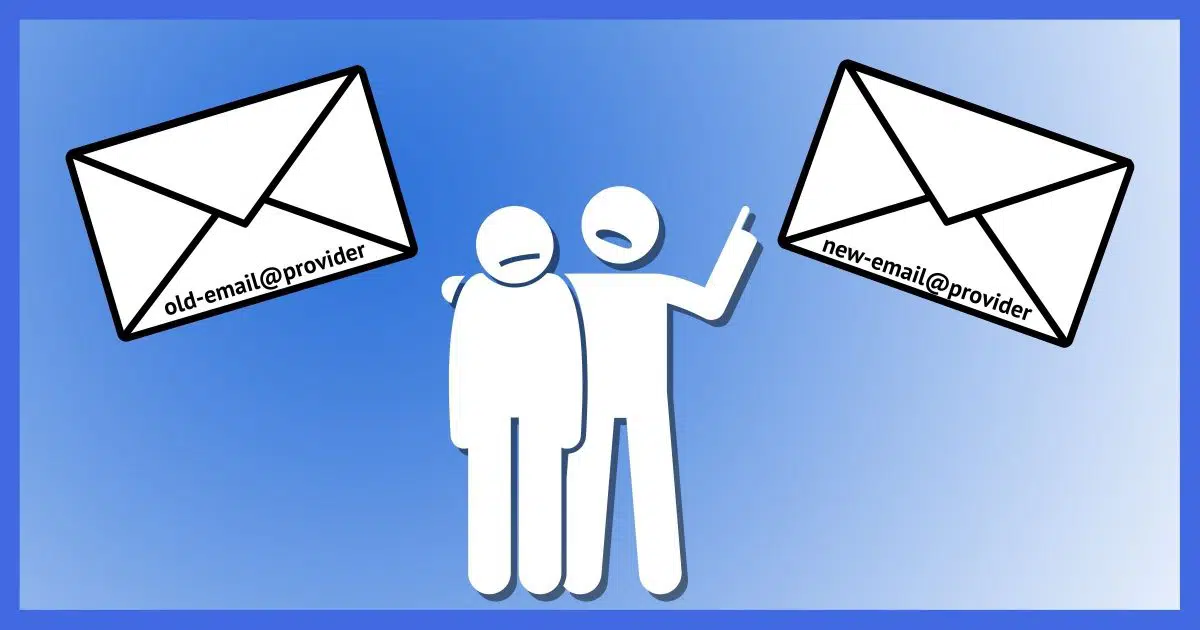
Though people ask about this frequently, the answer is rarely simple. Changing an email address often means one thing to the person asking and something very different to email providers.
Some services make the change easy(ish).
Others? Not so much.

Changing your email address
To change your email address:
- Create a new account at an email provider.
- Begin using that new account.
- Change your registered email address on all online accounts.
- Change your email address for every newsletter subscription.
- Tell your contacts to use your new address.
- Stop using your old email address.
What it means
Changing an email address is conceptually simple. You used to get email at oldme@randomisp.com, and now you want to use newme@somerandomservice.com.
Everything about those email addresses is different:
- the username (“oldme” versus “newme”),
- the email domain (randomisp.com versus somerandomservice.com)
- the provider (Random ISP, Inc. versus Some Random Service, LLC)
Each email account has one email address that identifies it. Thus, changing your email address means setting up an entirely new email account, even if you’re staying with the same provider.
Help keep it going by becoming a Patron.
A new email address for an online email provider
Let’s assume both our old and new email addresses are for free online email account services, like Yahoo!, Gmail, Outlook.com, or any of a host of others.
The process looks like this:
Related

How Do I Move Emails From One Account to Another?
Moving email from one account to another just takes some configurating and drag-and-dropping.#167850
- Create a new account. This gives you a new email address.
- Tell all your friends to use that new email address.
- Change the email address on record at all other online services you use (like stores, social media sites, newsletter subscriptions, online registrations, and so on). All of them.1
- Export your contact list from your old account and import it into your new one, if possible. If you cannot, begin building your new contact list from scratch in your new account.
- Start using your new email account.
- Move any email saved in your old account that you want to preserve to your new account. (This is rarely easy. You can forward each email individually to your new address or connect a desktop email to both accounts using IMAP and copy the messages from one account to the other.)
- Watch your old email account for services you forgot to update with your new email address. Change your email address at those services.
- Watch your old email account for people who haven’t yet started using your new email address. Remind them (from the new address) to use your new email address and update their address books.
A new email address using an email program
If you already use a desktop email program like Thunderbird, Outlook2, or similar, the process is slightly simpler.
- Create a new account at the new provider.
- Configure your email program to use that new account as the default.
- Tell all your friends to use that new email address.
- Change the email address on record at all the other online services you use.
- Watch your old email account for services you forgot to update to your new email address. Change your email address at those services.
- Watch your old email account for people who haven’t yet started using your new email address. Remind them (from the new address) to use your new email address and update their address books.
Because you store all your email and contacts on your computer, you needn’t worry about losing email. It’s all saved, regardless of what email account you use, and all your contacts are there as well.
But I don’t want a whole new account, just a new email address!
Many people just want a new email address that delivers to the same place their old email address did. Unfortunately, while email addresses and email accounts are technically two different things, in most cases, your email address is used to identify your email account.
Setting up a new email address means setting up a new account, with all the hassle that entails. Email providers make it difficult (if not nearly impossible) to move the information stored in one account to another.
Email sent to the old email address is delivered to the old email account, and email sent to the new email address is delivered to the new email account. End of story.
Or is it?
Related

The Wrong Way to Change Your Email Address
Emailing your entire contact list with a notice that you've changed your email address is NOT the way to change your email address. I'll show you what to do instead.#22453
Forwards, fetches, aliases, and the promise of change
If you can keep the old account, there are a couple of techniques that may let you set up a new email address or account and continue to manage your email in your old one.
Forwards
Many email services now provide the option to automatically forward email sent to one account to another.
For example, after setting up your “newme@somerandomservice.com” email address, you can tell the old “oldme@randomisp.com” provider to automatically forward any email sent to that old email address to your new email address. You need to log in to your old account periodically to make sure it’s not shut down for lack of use, but other than that, you rarely need to touch it.
You’ll get email sent to the old address delivered to your new account. If you want to send email that looks like it comes “from” the old email address, you’ll probably need to set that up with your new email provider. Some, but not all, email providers make this possible.
The problem with forwards is that they forward everything, including spam. This may cause your legitimate mail, forwarded from the same source, to be more likely to be erroneously flagged as spam. Check your spam folder periodically.
Fetches
Fetches are like forwards, but from the opposite side. Rather than telling the old email service to automatically forward all email to the new, we configure the new email service to periodically fetch the email from the old one.
We usually call this a “POP3” operation, because it’s set up just like configuring a desktop email program with POP3 to download your email. The difference is that rather than downloading it, you’re simply moving it from the old email service to your new one.
Once again, if you want to send email that comes “from” the old email address, it may take extra steps, but many services that offer POP3 remote fetching also make this a little easier.
Aliases
An alias is an additional email address configured with your existing email provider that delivers to the same email account. In fact, one of the most common uses of Outlook.com is to add an @outlook.com email address to an existing Hotmail account. Both are delivered into the same outlook.com account interface.
The process keeps changing, but as of this writing, you can visit account.microsoft.com, click on Your info on the left, then Edit account info on the right. Then, in the “Account username” section, click Add email.
The promise of change
Google has announced the ability to add additional email addresses to an existing Gmail account. This hasn’t rolled out yet, so we don’t know the specifics. On the surface, it sounds similar to an email alias, as described above.
I have to stress that in all three cases, you must have (and keep) access to both the old and new accounts to keep the forwarding, fetching, or aliases working.
What if I don’t have access to the old account?
This discussion is about an orderly, planned transition from one account to another, and assumes you have access to both.
Unfortunately, one common reason for changing your email address is that you’ve lost your old one and can’t get it back.
When that happens, there’s little to be done. The best you can do is to set up your new account, tell all of your contacts (the ones you can remember, anyway), try to change your contact email address at your various online services, and move on with your life.
Related
How Do I Get an Email Address for Life?
Tired of changing your email every time a service shuts down or your ISP changes? Learn the smartest way to secure an email address that’s truly yours for life, and why relying on free or “lifetime” promises could leave you stranded.#30699
Your own domain: the ultimate answer
If you’re going to make a new email address, here’s a recommendation.
Buy your own domain and set up access to an email address on that domain using the email provider of your choice.
There are two big reasons for this.
- Your email address — the email address you share with the world — is then no longer tied to any service. It’s yours for as long as you choose to own the domain, regardless of what email service you use to access it.
- You can change the service you use. If you set up access via your Google account, and then learn that Google is removing that ability, you can change it to be accessed by almost any other email service that supports it. Your email address remains the same, even though you change how and where you access your email.
There’s one other benefit. All the cool names are available when you own your own domain. The name “leo” (which is almost always taken on every email provider long before I ever get to it) is always available on every domain I own. So I can be “leo@” whatever domain I have.
And for the record, this is exactly what I do. My email address leo@askleo.com is accessed by FastMail. It used to be routed through Gmail, but when Gmail discontinued that ability, I switched. My email address didn’t change, only how I get it.
Do this
One of those newsletter subscriptions you should update with your new email address? Confident Computing, my weekly collection of solutions, answers, and tips in your inbox every week.
Not subscribed? You can sign up right here.
Podcast audio

Footnotes & References
1: This assumes that you are indeed changing your email address, and your goal is to stop using the old one at some point. If you’re keeping the old email address and simply adding a new one, you don’t need to do this unless you want to.
2: Outlook (classic), the program (part of Microsoft Office), not the unrelated website (Outlook.com). If the difference isn’t clear, please see What’s the Difference Between Outlook, Outlook, and Outlook.com?

I can confirm that outlook.com allows aliases. After initially creating my account I decided I wanted to use a different address, and the alias let me do just that. The “name” of the account is still the original address I chose, but when sending email I can choose which of the two addresses to send “from”.
Just one other minor point about Outlook (the desktop program as opposed to the outlook.com online email service). The article assumes that email accounts in Outlook desktop will all be set up as POP3 and therefore everything will be stored locally. That’s often not the case nowadays as accounts may be set as MAPI so that Outlook doesn’t deliver to a local .PST file. You’re just working directly on whatever is on the email server. I agree, though, that a POP setup is one way to make sure you have a local backup of your emails. (But beware of those POP3 settings that instruct the system to delete messages from the server once downloaded. If you need to access that email account from a different device you could get very confused as to why some email is missing.)
By MAPI I assume you mean IMAP. 🙂
One thing I’d like to add, is that some websites and services can be aggravating when trying to change an email address. Recently, I decided to stop using an alias address (@hotmail.com) and just go with @outlook.com.
Most of the services where I where I was using name@hotmail.com were fairly straightforward as to making changes. A couple required me to actually call their technical support to make the changes. And, then there were 2 that I had to close the account altogether and create a new one. I actually had one tech support type ask me to contact Microsoft and attempt to recover the old email address, after being informed that I no longer had access to it.
When you delete an alias that is used for Outlook.com, be 100% sure you are ready to do so. Microsoft is very clear that once deleted, it is gone with 0% chance of getting it back.
One of the side benefits of deleting the alias was that for a long time, it was my primary email address. Three months later, my spam folder is still empty. I wonder how long this state of happy affairs will last.
Leo, your suggestion of obtaining your own domain in order to facilitate E-Mail management is fine if you have money.
But if — like so many of us, but apparently not you — one doesn’t have that kind of money, then one is screwed.
(It also strikes me as rather a case of overkill, but that’s another story.)
It only costs $10-$12 a year to have your own domain.
Honestly, domain ownership is cheap these days. $15/year maybe? Including email forwarding. For people that expect to have email for a long time, and particularly for businesses, cost is simply not a barrier. Whether it’s overkill is another story – if you have ABSOLUTE father that your FREE email provider will be there for you always, and that you’ll never have a problem with your account, than sure.
Not everyone can afford their own domain, Leo. I, for example, am on a fixed income. And somehow I can’t imagine that owning your own domain is inexpensive. (And that’s setting aside the point that what’s “inexpensive” to one person will be “prohibitively and monstrously expensive” to someone else.)
Owning a domain is very inexpensive. I pay between $10 & $12 a year for registration. Unless you are looking for a hard to get name, there is no purchase fee.
$10/year — I’ve seen lower, I’ve seen higher.
Leo, something is very seriously amiss here; all of my mental alarm bells are ringing like crazy. $10 per year??? Impossible. Just… impossible. That’s too good — far, far too good — to be even remotely true. Did you mean $10 per month? That — $120/year — sounds vastly more plausible, and certainly a lot more reasonable.
And quite frankly, there’s a terrible disconnect between what you are saying, and what I’m seeing. When I glance at domain registration sites, what I see is something like this (a quick perusal of one domain registration site, but pretty much in line with others I’ve seen) —
thegrandslam.com
Premium Domain
*First Year Cost Renews at $13.99/year
$4,688.00*
thegrandscheme.com
Premium Domain
*First Year Cost Renews at $13.99/year
$4,288.00*
thegrandmarketplace.com
Premium Domain
*First Year Cost Renews at $13.99/year
$688.00*
thegrandshop.com
Premium Domain
*First Year Cost Renews at $13.99/year
$988.00*
thepaintpot.com
Premium Domain
*First Year Cost Renews at $13.99/year
$2,988.00*
thepalestine.com
Premium Domain
*First Year Cost Renews at $13.99/year
$2,988.00*
thepalindrome.com
Premium Domain
*First Year Cost Renews at $13.99/year
$988.00*
…and so forth and so on. Notice that the lowest cost on that list is almost $700. It gives me shudders to think what “TheGrandRascal.COM” would cost me! Given all of this, I’m having a real problem swallowing your claim of $10 per year. So, what’s the skinny* here?
—–
*What’s the skinny? – I confess, I’ve never truly quite understood that expression. I take it to mean, “What’s the truth?”, and as such I use it here, even if that’s wrong. 😮
I checked on Godaddy.com and found process have gone up since I registered my domains, but it still costs under $20 a year to renew. Go Ddaddy tells me I can get thegrandrascal.com $18.90 a year. Some registrars are cheaper but GoDaddy is one I expect to be around a long time. Top level domains such as .info are even cheaper. Hurry before someone registers it and holds it hostage till you pay 🙂
The only downside with GoDaddy is that they have relatively poor customer support, and a heavy sales pitch. I purchase all my domains from SimpleURL.com. Great customer support from George. (And if he goes away, he’s actually an enom.com reseller, so there’s a contingency plan that retains my ownership and access.)
Good to know. I’ve never used GoDaddy. I’ve never used them. I just went there to check the going rates.
Just an update to my previous post on April 29, 2020: Since switching my email from Hotmail.com to Outlook.com and being more mindful of which sites I use my current email for, there was a significant decrease in spam mail. I didn’t think it would work out as well as it has. I get zero spam messages now.
I’m about to do the same with my wife’s email, as she is getting flooded out. Checking Have I Been Pwned, her email was involved in just one breach. None of mine have been. Will see if lightning does strike twice.
For me this is a lot to take in. If I’m understanding this correctly, I can keep my email address, which is {email address removed} even though I am moving out the the area that Optimum serves. Who do I contact, ex Google or Outlook, to be able to keep the Optimum email addresses that I currently use.
No you likely cannot take your ISP-provided email address with you.
I learned that you can add + to your email and still get it delivered to same inbox but can be helpful to filter. So eg johnsmith@gmail.com and john smith+shopping@gmail.com both deliver to same inbox.
You mean johnsmith+shopping@gmail.com. Spaces are not allowed in email addresses.
@Sally Morton, I just performed a test to see if you have to right, and it appears that you do. From my Outlook account, I sent myself a test message, but with “+Test following my user name, so for the fictitious address of ‘someGuy@gmail.com’ I used this: ‘someGoy+Test@gmail.com’ as the destination address, and the test message arrived in my inbox on my Gmail account.
Ernie
This does not work for all email providers, but is a useful gmail feature.