The news isn’t good.
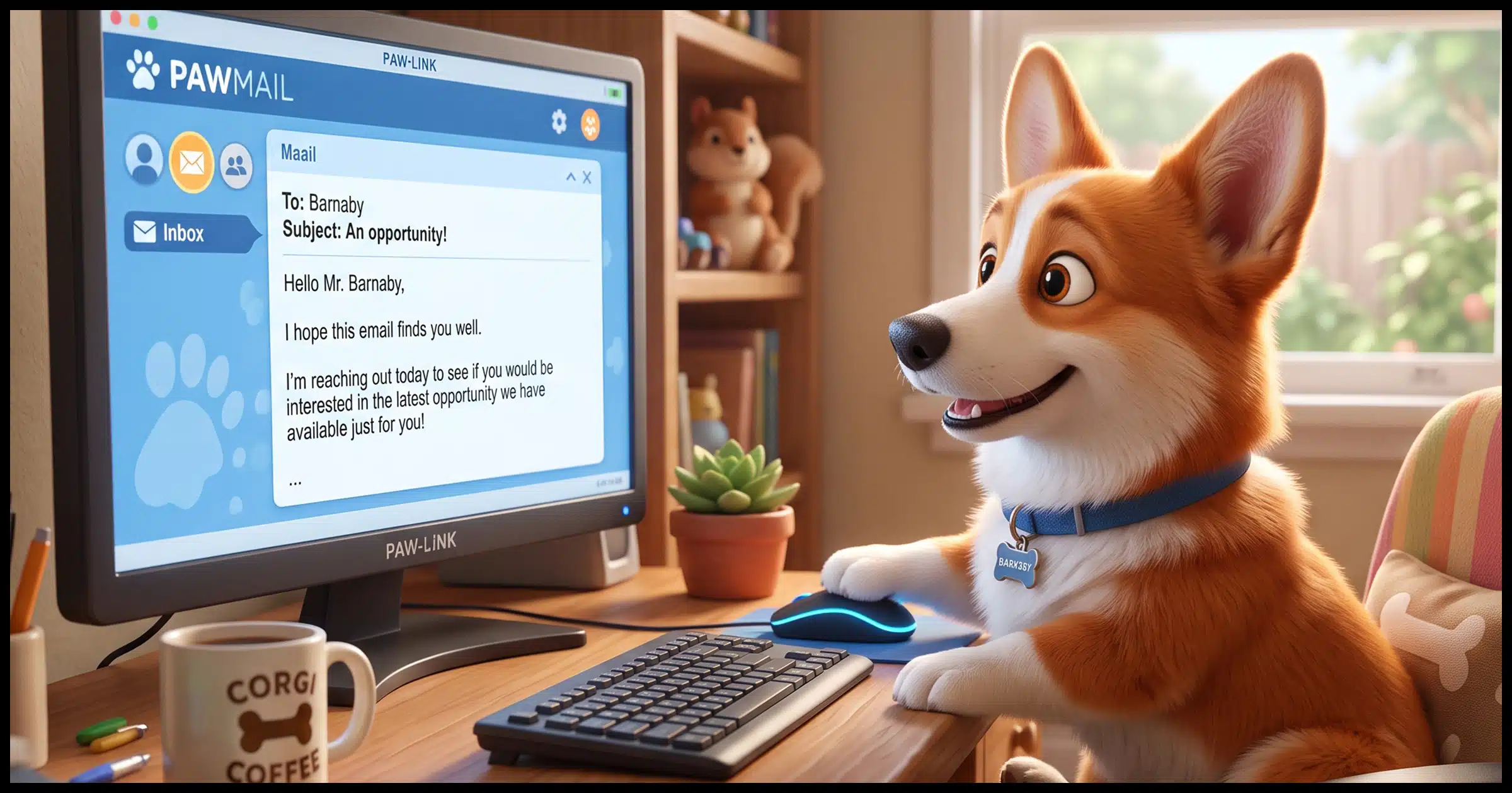
Sure.
It could also have been written by a human.
While there might be subtle clues in today’s AI-generated text, as I keep saying, it’s only getting better.

AI or Human written?
You can’t really tell anymore. AI writing is getting too good. Old clues, like perfect grammar or odd wording, are fading. Don’t judge an email by how well it’s written. Judge it by what it asks you to do. Your scam detector still matters most.
Using AI to craft AI
I’ve never had AI craft an email for me, so I asked Claude (using the Fable 5 model1):
What’s a good prompt to you to have you write a solicitation email for me? Say, a prompt to get you to write a message to someone I want to hire?
It responded with:
Claude (Fable 5)
The key is giving me the specifics I’d otherwise have to guess. A good prompt covers who, what, why them, and what happens next.
Write an email to [name], a [their role/background], asking if they’d be interested in [the role/project]. I found them via [how you know of them — referral, their work, LinkedIn]. Key selling points: [pay/flexibility/interesting work/etc.]. Tone: [warm and casual / professional]. Keep it under 150 words, and end by asking for [a 15-minute call / their rate / a reply].
It also included an example version of that prompt with the placeholders filled in.
I then asked:
Write an email to Sally, an unemployed retail worker, asking if they’d be interested in a work-from-home technical support job. I found them online via their Linked In profile. Key selling points: flexible hours, work from home, interacting with a wide variety of people. Tone: warm and casual. Keep it under 150 words, and end by asking for a reply.
Here’s what it came up with:
Claude (Fable 5)
Subject: Work-from-home tech support role — thought of you
Hi Sally,
I came across your LinkedIn profile and wanted to reach out. I’m hiring for a work-from-home technical support position, and your retail background caught my eye — helping customers troubleshoot problems face-to-face is a lot of what this job is, just over the phone and chat instead.
A few things you might like about it: flexible hours you can shape around your life, no commute since it’s fully remote, and plenty of variety — you’d be talking with all kinds of people every day.
If that sounds interesting, I’d love to tell you more about the role and hear what you’re looking for. Just hit reply and we’ll go from there.
Best,
Leo
About 125 words. Note how the retail experience gets reframed as a genuine qualification — that’s the “why them” doing its work.
If you got that mail out of the blue, would you think it had been written by a human?
If you were looking for a job, would you reply?
Help keep it going by becoming a Patron.
The uncanny valley applies to writing
The “uncanny valley” typically applies to our visual perception of the human form. If it’s obviously human, that’s great. If it’s obviously not human, that can be great, cute, or disturbing, but it’s clear what it is.
When it’s not-quite-human and not-quite-not-human, things get weird and “uncanny“.
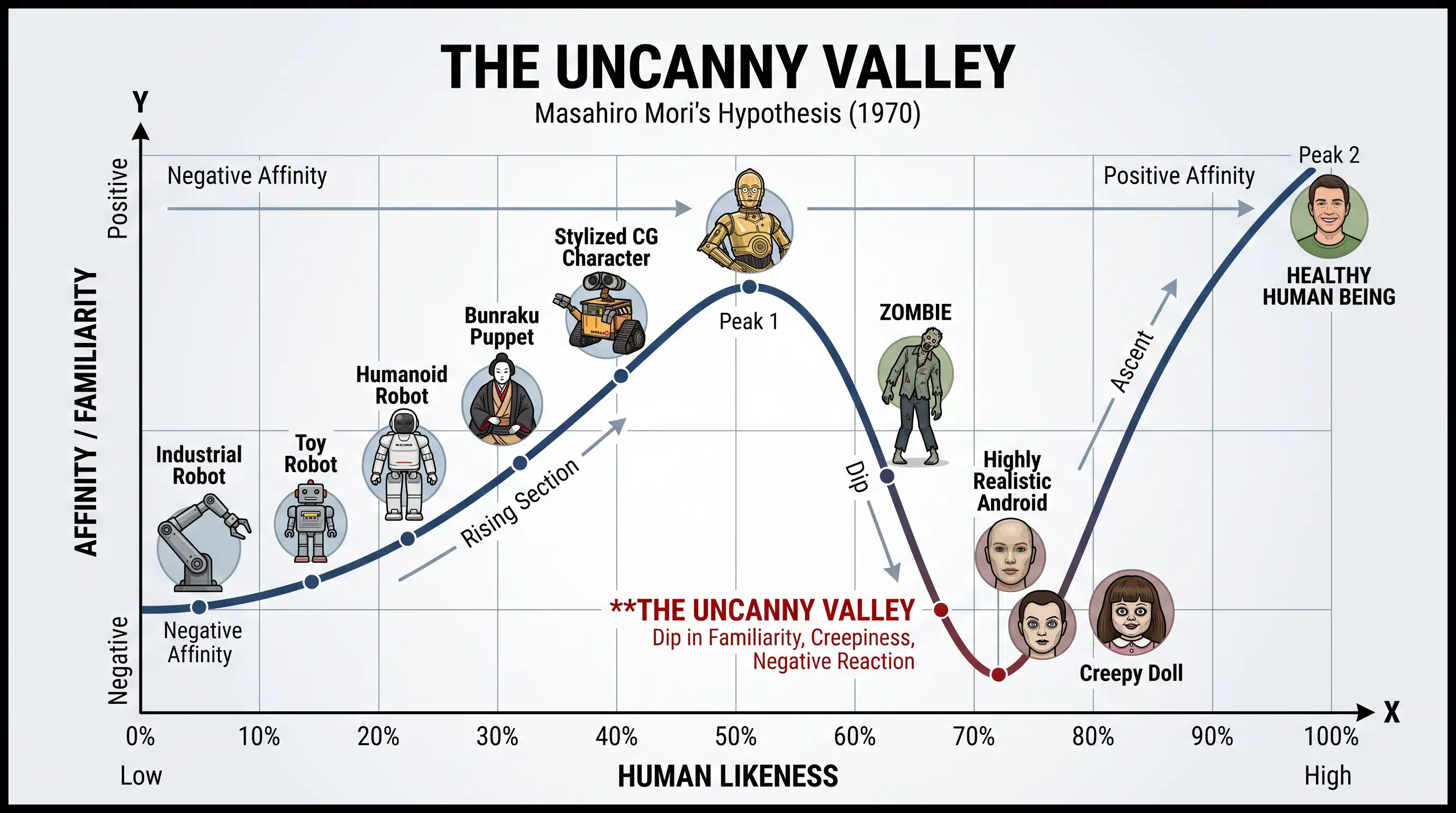
The same concept can be applied to writing. Bad writing is clearly bad. This can be for a variety of reasons, ranging from having a different native language to having poor writing skills.
What I’ll call “natural” writing is also usually obvious. It typically has a style, a rhythm, and perhaps a collection of nuances unique to the writer, but it reads as normal or natural.
Read that email above again. Does it read as normal and natural?
My take is that while I see it somewhere near the right side of the uncanny valley, it’s close enough to fool most people, especially people for whom English is not their native tongue. I might think twice about it, but a) it’s on my radar to keep that kind of thing in mind, and b) I write for a living these days.
Related
More Tips to Protect Yourself from AI Scams
AI has entered the chat. And the email. And the voice call. And the video. It's making scams even harder to detect.#176909
Obvious signs are disappearing
It used to be fairly obvious. AI didn’t use contractions (“I am” instead of “I’m”), for example. The writing was robotic in tone and terminology.
Even now, in our examples above, AI seems to use the em-dash (“—”) more often than a natural writer would.
Yet AI continues to improve. Those and other signs are slowly disappearing in AI-generated text.
Perfection could be a sign
Very few people write perfectly. Even those of us who do it for a living often make mistakes.2 Usually, those mistakes are infrequent and subtle, but they’re there.
AI-generated text typically doesn’t include errors. It’s one of the reasons overseas scammers love using it, because what was once a clear sign of a scam — broken English — is now easily avoided3. The result is messages in grammatically perfect English.
I’m tempted to say unnaturally perfect, but I don’t want to offend those humans among us who naturally write 100% accurately.
So, it’s perhaps a sign. For now. It wouldn’t surprise me if AI were to begin to introduce natural errors, either on its own or at the instruction of whoever’s using it.
Does it really matter?
AI usage is controversial. But at the end of the day, does it truly matter whether AI was used? Ultimately, it’s just a tool, after all.
The content of the message matters more.
A scam is a scam, no matter how well it’s written or who wrote it. We still need to rely on our manure detectors when reading any message. Yes, we’ve perhaps lost one signal: proper English is no longer a sign of legitimacy, but was it ever really something you could rely on entirely? Of course not.
At the other end of the spectrum, if a message moves you, speaks to you, or informs you in some significant way, does the possible use of AI dampen the message? I know some will say yes, but my take is no. Something that speaks to me speaks to me regardless of the source.4
Do this
Do not over-rely on how a message is written to determine whether it’s legit or not. Scammers have access to AI, as do normal people. Similarly, don’t rely on imperfection as a sign either way.
And don’t over-fixate on whether or not AI was used. As controversial as it may be, it’s just another tool that anyone can use for good or evil.
Subscribe to Confident Computing! Less frustration and more confidence, solutions, answers, and tips in your inbox every week.
Podcast audio

Footnotes & References
1: Supposedly the most capable and advanced AI model as I write this.
2: Just ask my editor. 
3: And, yes, real people use em-dashes as well, so that’s not always a clear sign.
4: An interesting essay on this topic: In 5 years, nobody will give a damn about AI-detectors, by JA Westenberg.

I’m no expert at writing or even typing. I won’t use AI until it’s proven to accurately convey my message and my opinion that I’m sending. So for now, I’ll use the free Grammarly extension on my browser. When I post on Facebook, write an email, or even reply to a topic in a newsletter, people should know that’s its coming from a human being and not AI. For me, this picks up most misspelled words or puts them in the correct order.
When I use AI to help compose an answer, I edit their “improved” answer to fit my voice. I use AI as a grammar/style (mainly style) checker. It sometimes points out things I’ve left out. I fact check any information they might add.
I don’t use AI except to ask questions or help me solve problems with my computer.
All emails and chat messages are written by me.
It’because I’m not that bad at English.
AI would have fixed the typo in the last line of your comment 😉
“2: Just ask my editor. 🙂 ”
Your editor is an exception. Mary Beth doesn’t make mistakes. 😉
I searched for Mary Beth and couldn’t find out if she’s involved in AI or owner of the paid version of Grammarly?
By the way your AI doesn’t spell check the word “use”.
She’s Leo’s editor. Before she started with Ask Leo! I’d find at least a couple of typos and rammatical errors in every article. Now, it’s been years since I’ve found an error. She’s amazing.
Mary Beth is my human editor.
My point is that she can easily tell you how many errors I make that you never see.
I’m just saying that before Mary Beth, I could easily tell you how many errors you make that people never see. 🙂
Boys, boys … stop arguing! 🙂
The point about judging an email by its request rather than its writing quality really resonates. My scam detector feels more crucial than ever, especially with AI-generated text becoming so polished and indistinguishable from human writing.
Actually, the question shouldn’t be “How do I tell if an email was written by an AI”. The question should be, “Is this email legit?” A fraudulent email from a human is just as dangers as one generated by AI.
It is probably as quick to write the email yourself as it is to give AI the instructions it needs to write it for you.
It’s not about saving time. Often it’s about getting the grammar and phrasing rigt. Even tools like Grammarly use AI to help improve grammar and style.
I’m not much interested in using AI in what I write, including here. I much prefer to put down on the screen what I want to say, review/proofread it, and repeat until I’m satisfied with the organization, content, clarity, and conciseness without sacrificing detail where appropriate.
With that said, do I care if something’s written by AI? No! I care more for the accuracy, clarity, conciseness, and organization of the content much more (just as I do about my writing). When a topic is complex. highly detailed, and dry, AI could make the item more palatable for the reader.
As for all those scams, and how sophisticated they’ve become (AI or not), I still apply the same rules I always have, essentially – never blindly trust anything coming from the Internet, and never trust that any hyperlink will take me where the label claims. These days, if I receive a message requiring that I go to a specific website to update my information, I use my password manager to navigate to the appropriate website, and check whatever the message requested in the assumption the request was fraudulent, and if so, move the fake message to my spam folder.
FWIW, I attribute my interpretation of zero-trust security to why I take such measures. Besides, If I never click hyperlinks coming from the Internet, those undetectable scam messages won’t work, regardless how well orchestrated they are, now will they?
Ernie
To me, right now AI is a little scary/annoying/potentially helpful/amusing. Wouldn’t an issue be who’s in control, AI or the human writing to us? In other words, it should be a tool but not a runaway dictator. Our secret fear.