First, do no harm.

There is no “best” registry cleaner.
There are a wide variety of opinions on registry cleaners and PC cleaning tools. Many people believe they’re valuable, important tools to keep your system running smoothly.
I disagree. Strongly. Most of the time, they’re so much snake oil.

The Best Registry Cleaner?
The best registry cleaner is no cleaner at all. Registry cleaners are rarely needed and rarely effective. Some so-called registry cleaners are just scams. Reputable registry cleaners, such as CCleaner and JV16 Power Tools, can be used as a last resort if nothing else has helped. Regardless of which you use, always back up completely first.
Registry cleaners are rarely needed
I rarely use a registry cleaner.1 In fact, I’ve never felt I’ve needed to use a registry cleaner. I only run them to experiment with the cleaner, not because I feel my system would benefit.
And I definitely install and play with random things on my machines all the time. That kind of “playing” is exactly what most registry cleaning advocates say leads to registry issues — yet I’ve rarely had issues, and when I did, registry cleaners weren’t the solution.
The best registry cleaner is no registry cleaner at all.
Help keep it going by becoming a Patron.
Related
My Registry Scan Reported Hundreds of Errors! Which Do I Fix?
Registry scanners often report hundreds, if not thousands, of issues. Should you fix them, and if so, which? Here's my approach.#2893
Registry cleaner risks
In my experience, most computers don’t benefit substantially, if at all, from a registry cleaning. Some even get worse.
Many people reach for a registry cleaner when an application is having problems, or Windows is misbehaving. The problem is, these types of situations rarely respond to cleaning; they often require an application-specific or Windows-specific solution.
I do get reports of cleaners making things worse. I’ve even heard from individuals who’ve had to completely reinstall Windows after running a registry cleaner that did much more harm than good.
When to run a registry cleaner
In my opinion, registry cleaning is appropriate in only two cases:
- To attempt to speed up a very slow Windows machine, but only if nothing else has helped.
- To resolve Windows or application crashes, but only if nothing else has helped.
I consider it a last resort. While it might help, it’s not likely to help much.
Back up first
Before you run any cleaner, back up first.
This is one of the few times I’ll consider using system restore, as it is nothing more than a glorified registry backup.
I prefer, however, to take a full system image backup. That way, if anything goes wrong — including a system restore failure — you can safely restore your machine to a point in time before the damage was done.
Safe registry cleaning
There are those who disagree with my position. Sometimes loudly.
And, to be honest, while there are horror stories, most of the time cleaners don’t do any damage. They may not do any good, but reputable ones aren’t going to harm your system unless there’s some other kind of underlying problem.
Since you can’t tell whether your situation is going to be one of those “mostly harmless” scenarios or a total disaster, it’s critical that you back up properly before you begin.
Which registry cleaner?
If you’re going to use a registry cleaner, which one should you use?
There are plenty of tools out there. I’ll mention two:
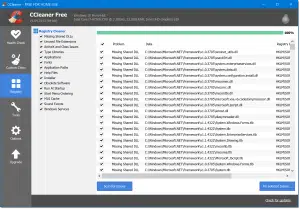
- CCleaner, a Windows cleanup utility that has a registry cleaner as well. Run “Analyze,” and you’ll see the changes it is about to make. Caveat: CCleaner’s setup program has been known to install PUPs if you’re not careful at install time. Also, while they take great pains to push their paid version and paid support, neither is required; the free version is all you need.
- JV16PowerTools includes not only a registry cleaner but an entire suite of useful maintenance utilities.
I’ve used both these tools on an otherwise clean and working copy of Windows and had no issues.
Do this
Don’t jump to a registry cleaner unless it’s your last resort while addressing an issue of some sort.
Do back up your machine before running one.
Do subscribe to Confident Computing! Less frustration and more confidence, solutions, answers, and tips in your inbox every week.
Footnotes & References
1: While I use the term “registry cleaner” throughout, my thoughts apply to all forms of generic “PC cleanup” utilities, most of which include registry cleaning as one aspect of a larger, still ineffective, toolset.

> What’s the best Registry Cleaner?
Huh. I can guess your answer before you even say it (chuckle):
> “None.”
I have used Glary Utilities for over 10 years. I think it is great.
Microsoft, now, has Microsoft PC Manager, its own Registry Booster and Cleaner. I imagine being from Microsoft, it’s safer than the others (a low bar), but I still don’t see any real need for it.