Why, indeed.
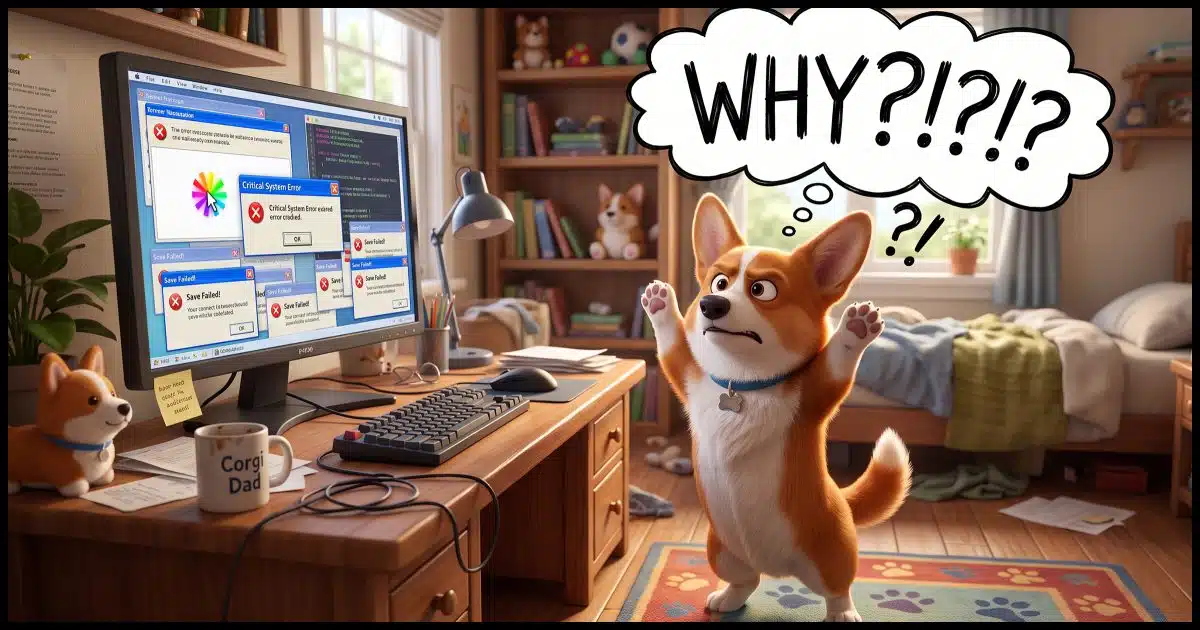
I was helping a friend the other day with some Windows issues, and a not-uncommon question came up, one that I often dread.
“Why?” As in, “Why did they do that?”
It’s a common question that gets applied to computers and software of all generations and iterations. Recent versions of Windows have certainly generated a healthy share of “Why?” questions — but trust me, it’s nothing new.
The problem is, asking “Why?” is most often a frustrating and fruitless exercise.

Why?
Asking why about tech rarely helps. If you’re annoyed, save your energy. Real answers are rare, and even if you get one, you might still feel stuck. But if you’re curious about how something works, go ahead and ask. That kind of “Why?” can teach you something.
Don’t ask out of frustration
Faced with something they don’t understand, can’t comprehend, or don’t like, many people ask “Why?” out of frustration.
Why were decisions made the way they were? What were they thinking? The questions may be a way to emphasize just how much the questioner disagrees with those decisions. They’re not really looking for an answer.
That’s a good thing, because most of the time, there is no answer. Expecting one — in particular, one that would allow you to make peace with whatever issue you’re facing and thus be OK with it — is just going to provoke you.
Searching for a why out of frustration is energy wasted.
To get all Zen for a moment, it is what it is.
Getting frustrated, demanding to know why, or even understanding why isn’t going to change any of that. You don’t have to like it, but it’s probably best to accept whatever it is and make decisions accordingly.
Help keep it going by becoming a Patron.
Related

Change for the Sake of Change?
People often complain that the latest update to their favorite software is just "change for the sake of change". No. Just... no. Nothing could be further from the truth.#19522
When the why isn’t the real why
One of the most frustrating responses to “Why?” is what I refer to as marketing-speak. You could even call it misleading or misdirecting marketing-speak.
This happens when the source of our frustration believes we can’t handle the truth, or doesn’t want to share the truth, and gives us some corporate line about why a specific change was made.
A company might say it made a change because testing revealed the result was better, stronger, faster, or whatever. In reality, the change was made to further some agenda. That agenda might be about:
- Selling more product (not something the company wants to admit publicly).
- Unifying some underlying technology (rarely a selling point).
- Laying a foundation for some future direction (that the company can’t yet admit to for competitive reasons).
Or it could be some other random reason.
Whatever the reason, it’s clear to those of us who use the resulting change that it’s anything but better, stronger, faster, or whatever.
Once again, the reason doesn’t matter. It is what it is. They did what they did for whatever reason they did it.
Live with it or seek out alternatives. In either case, move on.
Often, the answer doesn’t help
Sometimes, you get lucky and find out why something is the way it is. And once you know why… you’re no better off.
“Why did they change the user interface?”
“So it would be consistent across all kinds of devices.”
“But I don’t use other devices. Besides, it doesn’t work on the device I have.”
Doesn’t matter. That’s what they did, and that’s why they did it. Maybe it makes other people happy. Maybe someday it’ll make you happy when you get another device. Maybe it’ll never make you happy. Doesn’t matter. It is what it is.
Sometimes understanding why doesn’t help.
Ask “Why?” out of curiosity
I don’t want to make it seem like you should never ask why. “Why?” is an important question when you’re curious. When you’re trying to learn how things work, “Why?” is often an important step to making better use of it.
A genuine “Why?” often uncovers reasons that can help you make sense of how things connect and relate.
When you ask “Why?” in an attempt to learn something, it may occasionally be out of momentary frustration, but you’re genuinely interested in the answer.
On the other hand, asking why out of pure frustration because you encounter something you don’t like is rarely educational or helpful.
Do this
If you’re genuinely curious, go ahead and ask why to learn from the answer, if an answer is available.
But if you’re just frustrated, asking why is likely to frustrate you more. Don’t bother. As best you can, accept what frustrates you. If that means you need to make changes — say using something else that frustrates you less — that may be a better option.
Subscribe to Confident Computing! Less frustration and more confidence, solutions, answers, and tips in your inbox every week.


Based on my experience with a well-known company (which went out of business due to its well attested short-sightedness), it’s because the company made REALLY STUPID business decisions that went in the wrong direction at the wrong time. Companies get complacent, run out of ideas, don’t anticipate trends, underestimate competition, etc. It happens all the time. So if you find yourself asking “Why?” it may be time to turn to another company’s product or technology, or simply bite the bullet and learn a new technology. The alternative is to go down, crying and moaning, with the ship you’re currently riding on.
Thanks, Leo for providing insightful prospective on the question of asking, “Why”. I understand. So what do I do with a 2002 Dell 1520 computer that is clean and in good working condition if I buy a new machine with Windows 8.1? How do I recycle this lovely machine ( a gift from my children)? Should I hold onto it to experiment with the alternatives?
There are many places to donate a working used computer. Or you can consider this your opportunity to play with Linux. That’s what I plan to do. I’m converting my old XP machine into a Linux OS home entertainment system.
Linda ~ What Mark said. Just do a web search on “what to do with unwanted computers” or some such, and you will get at least a page or two of websites links for organizations that will put your old tech to good use. I recently got a refurbished laptop from c4pin, intentionally lower case, (computers for people in need}. They reset the system, load Linux and a bunch of vetted useful programs such as Open Office, and make the computers available at a very reasonable cost. c4pin has a veterans outreach effort, which made the connection for me. Look at thier website for the options, or any of the other I’m sure.
Probably the most common Why? question in people’s minds today is “Why did Microsoft take away the Start Button and give us the Tiles interface instead?” I’ve come up with a speculative answer. I think they wanted to introduce people to the Microsoft RT world. They hoped people would get used to that interface then want to buy Windows phones and tablets. This would also create a market for the Windows store to be able compete with Google Play and iTunes. I believe what set Apple apart in this aspect was that Steve Jobs had the insight to understand how the average consumer would react to his products. This is a very rare talent.
Microsoft has always wanted a unified user interface across all of its offerings – that’s actually nothing new. (For example there was a start menu on old Windows CE based devices if I recall correctly.) What was rare this time around is that they changed their flagship product, Windows, to try to make it happen. I’m of the opinion that different devices require different – sometimes radically different – interfaces. Portable devices don’t need start menus, desktops do.
To Me another why, is why did they introduce the outlook.com name, I think it was a really stupid idea, as most of you will know the constant comparison with outlook for office suite, is so frustrating. I am often having to educate people that they are totally different. Surely a much better name could be msmail.com. this could have killed the confusion immediately.
Microsoft has a history of choosing poor names. Outlook versus Outlook.com is just one of them. There’s no point in asking why — clearly someone thought it was a good idea.
Contacting any company asking why something was changed will often cause the recipient to give some off the cuff answer that in many (or most) cases leave the questioner no better off and quite probably confused.
Having said that, it’s very productive for consumers with dislikes, problems or a ton of ‘Why” questions to contact the company. I was asked recently “why” even bother with that. If consumers do not frame accurate, to the point and direct proper concerns to the company they will continue down whatever path they have chosen for whatever reason never knowing that their most important business concern, the consumer, is unhappy, confused or very likely to find a substitute item of equipment!
If you’re truly unhappy or concerned about something don’t continue to use it, find something else, return it for a refund or take whatever action makes you happy. Life is far too short to sit around unhappy, unable to get something to work the way you want it to work or just not working period.
By the way if you’re not a computer engineer, a programmer or some other flavor of “computer expert” (like I’m not) the answer to many why questions would be far to complicated to do us any good. Venting may feel good but it usually doesn’t do much good. I know because I’ve done a lot of venting.
Here’s my theory of “Why”. In a previous comment, I said “I believe what set Apple apart in this aspect was that Steve Jobs had the insight to understand how the average consumer would react to his products. This is a very rare talent.” It seems like most software engineers just don’t have that insight.
Software designers: Be like Steve.
Absolutely right that software developers don’t have a clear appreciation of product usage, the customer or business issues of their company. That’s especially true of younger/new developers whose primary focus is on the lines of code, not the product. Without adult supervision the typical software person will want to change the code as soon as it’s done and works. Change it because they think they can do it “better”, faster, more elegantly, with fewer lines of code, better than the other developer sitting next to them, or because they just heard about a new trend, tool, or method. These examples for change are not exaggerations and I classify them as “change for the sake of change”. So, when you ask why did the software change, it may very well be for some trivial and juvenile impulse. The response to this type of a “why” question is “… well because.”
Requiring bright young code-jockeys to spend part of their induction & training period manning front-line customer support lines (under adult supervision!) can help moderate the juvenile impulses somewhat.
Ours is not to wonder why
Ours is but to crash and cry
My father – during my childhood, advised me that the strongest question was “Why?” and to keep asking it until you get a satisfactory answer. From whoever.
That probably won’t ever happen with software giants. The answer to most of those why questions is poor design.
Thank you Leo!! I have shared a number of your articles with people who seem to think I am an IT guy (which I definitely am NOT!) and tried to train them to subscribe to your newsletter and come here directly.
But now, I have a terrific philosophical answer for a whole bunch more folks:
“Searching for a “Why?” out of frustration is energy wasted.
To get all Zen for a moment, it is what it is.
Getting frustrated, demanding to know why, or even understanding why isn’t going to change any of that. You don’t have to like it, but it’s probably best to simply accept whatever it is for what it is and make decisions accordingly.”
AMEN!!
I tend to take things as they come. When I ask “Why?”, it is because I want to understand how something works and NEVER about why someone made some frustrating change/decision. When an app/program/OS is changed in a manner I can/will-not live with, I consider making a change. I agree, getting frustrated over changes in software (etc.) is a waste of time. I can find many similar apps to replace anything I use on a regular basis, and experience tells me that the replacement may serve my needs better than what I was previously using. This was true for me when I switched from Word (Microsoft Office 10) to LibreOffice Writer for word processing, and more recently from SUMo to Patch my PC to get software update notifications. My suggestion is that id some program gets changed in a manner that makes it less useful to you, look for an alternative. If, when you uninstall the previous app to replace it with an alternative you have found, you are asked to answer a survey about why you are removing the software, do so, and tell the developers why you are making a change. Perhaps, if enough users follow suite, they will fix/undo whatever they did to alienate so many users (not likely, but you never know).
My2Cents,
Ernie
I recently had a “why” moment – and when I researched the problem, I found out that the answer was actually a good one. It didn’t apply to me, but I understood the reason, and became less frustrated. Thanks to the discussion on the forum, the developers made the original configuration an option on the next update. I don’t think a “why” – even in frustration – is necessarily bad, it’s just unproductive to get hung-up in the anger.
I don’t bother asking why anymore because it is mostly change for the sake of change. I just find another way when possible.
It’s almost NEVER change for the sake of change. That’s a horrid business model. Most changes have reasons — even if not obvious, or not something you agree with, there are reasons.
Leo, you wrote:
“It’s almost NEVER change for the sake of change. That’s a horrid business model.”
Oh, I get it! Businesses never, ever have horrid business models!
Right?
Many do. But to ASSUME change for the sake of change is an equally horrid assumption. I’ve not yet seen it to be accurate, even once. There’s ALWAYS a reason, and the reason is not “change for the sake of change”.
The closest I’ve seen to change for the sake of change are changes to make the interface “prettier”. Kind of like what they did in Vista. There were changes under the hood, but the esthetic changes were horrendous.
And yet the reason was NOT “change for the sake of change” — the reason was more along the lines of “Let’s make Windows easier to use, and compete more strongly against competitors”. They were WRONG, but there was a reason.
For anyone interested, I recommend checking out “The Story of the Ribbon”. A “live” webpage no longer exists but it is available in an archived format at https://web.archive.org/web/20171115112002/https://channel9.msdn.com/Events/MIX/MIX08/UX09. Jensen Harris was a program manager for the redesign of Microsoft Office 2007 and they go through and explain why Microsoft did what they did for Office 2007.
Just came across Jensen’s website and more about the design, plus their own upload of a video (they uploaded it on September 28th) on the webpage that I previously linked to.
https://jensenharris.com/home/office
https://jensenharris.com/home/ribbon
https://www.youtube.com/watch?v=YLZgNHEEnSE
I’m to the point that when Microsoft introduces changes to Windows I don’t ask “Why?”. Rather I’m asking “How?”.
I have found that when a change is made to Windows that I don’t care for, there are ways to revert back to how something worked before. My Start Menu and File Explorer are not what appears after a clean installation of Windows. Nor are the Context Menus.
When Microsoft introduces changes to Windows, they tend to be ovelayed onto what was there before. Using Group Policy (I run Windows Pro) and RegEdit can undo some of the changes.
When Microsoft introduces changes to Windows I don’t ask “Why?”. Rather I’m asking “How?”, how to I adapt. For example, at first I was confused with the Windows 11 Start Menu but when I played with it, I found it to be Windows’ most customizable Start Menu. It takes some learning and some work, but it’s very flexible.
Windows has about a billion users. There’s no way that every change the make will be useful for everybody. For example, I find Windows 11 Start Menu to be their most intuitive and customizable Start Menu yet. But it’s new and unfamiliar and takes some learning to get it to work as you want. An improvement, yes. Kind of like going from an older car to a modern one with gauges and controls you have no idea about. You quickly adapt to the new dashboard and it’s like you’ve been using it forever.
And if that’s too difficult, there are programs like Open Shell to tame the start Menu.
Why? Because they hate us.
You’re giving them more credit than they deserve. Depending on the “they”, they’re not even thinking about us.
Why? : A question I ask often … along with Who?, What?, When?, and Where?! When I’m unable to deduce a seemingly valid reason for a change, my default assumption is ‘Because change is inevitable!”, so, consider for a moment how dull and inflexible everything in life would be without it!
With that said, software and hardware changes are intentional, nearly always in the name of competition. When change benefits the user, I view that as a bonus. When the software I use changes, I see that as a new adventure for me to embark on in my effort to understand the effect that specific change or set of changes will have on my workflow, and how I can adapt so I change as well. When I encounter or learn of a change or new feature I determine to be detrimental, I seek out ways to mitigate or disable it, recording the procedure for future reference.
In the end, since all change is inevitable, and once encountered must be reacted or adapted to, I find that when the change is in software we use, reacting with anger or frustration is non-productive, and even detrimental to you … the user.
Ernie
Oh Leo, you have tripped the trigger that I have had for the last 42 years.
I have worked in retail my entire life. At one time I was a regional systems trainer for Kmart. I got that position because as a POS team lead I wrote an article that laid bare the inefficiencies in our POS software for the end user in preparation for an executive store visit. What was supposed to be a 20 minute visit turned into a 2 hour meeting.
We just upgraded to a new version of scheduling and payroll software at work. It is much prettier. But actually working with it, it takes many more clicks to accomplish the same task and keyboard shortcuts went away. Some things are better but others are worse.
At another employer I was able to reach out to the EVP of Store Operations to get our scanning software changed to eliminate unnecessary screens and clicks. When you do something hundreds or thousands of times a day, seconds add up and across a fleet of 1400 stores turns into a lot of money.
The root problem is the software developers never get to see how the end users actually use the software. As a result they don’t develop for efficiency of use but instead for prettiness. By field testing they are primarily concerned if it works easy and efficient to use.