Looking forward by looking back.
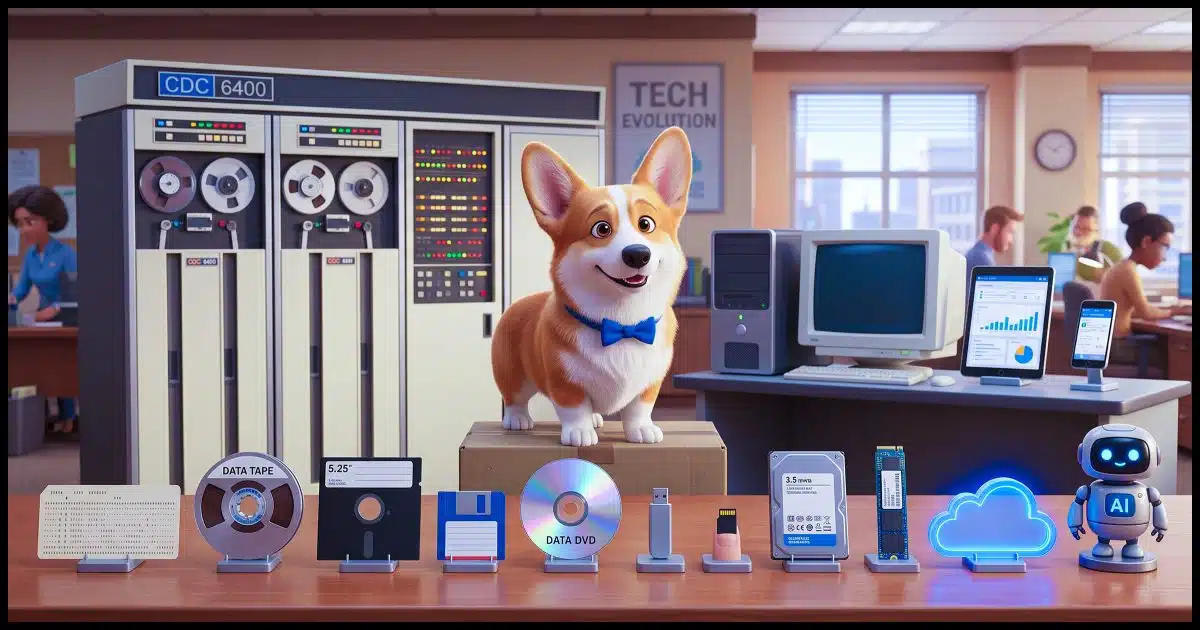
Some time ago, I was feeling reflective. This led to a discussion with a visiting friend about what their young son could expect over the course of his lifetime.
I started looking back to look forward. It turns out I have a lot to look back on.

Half a century leads to this
You never know what job or skill you will need in the future. The world changes quickly. The best thing anyone can do is learn how to learn, ask questions, and grow from mistakes. That way, you’ll be ready for whatever comes next.
Over 50 years so far
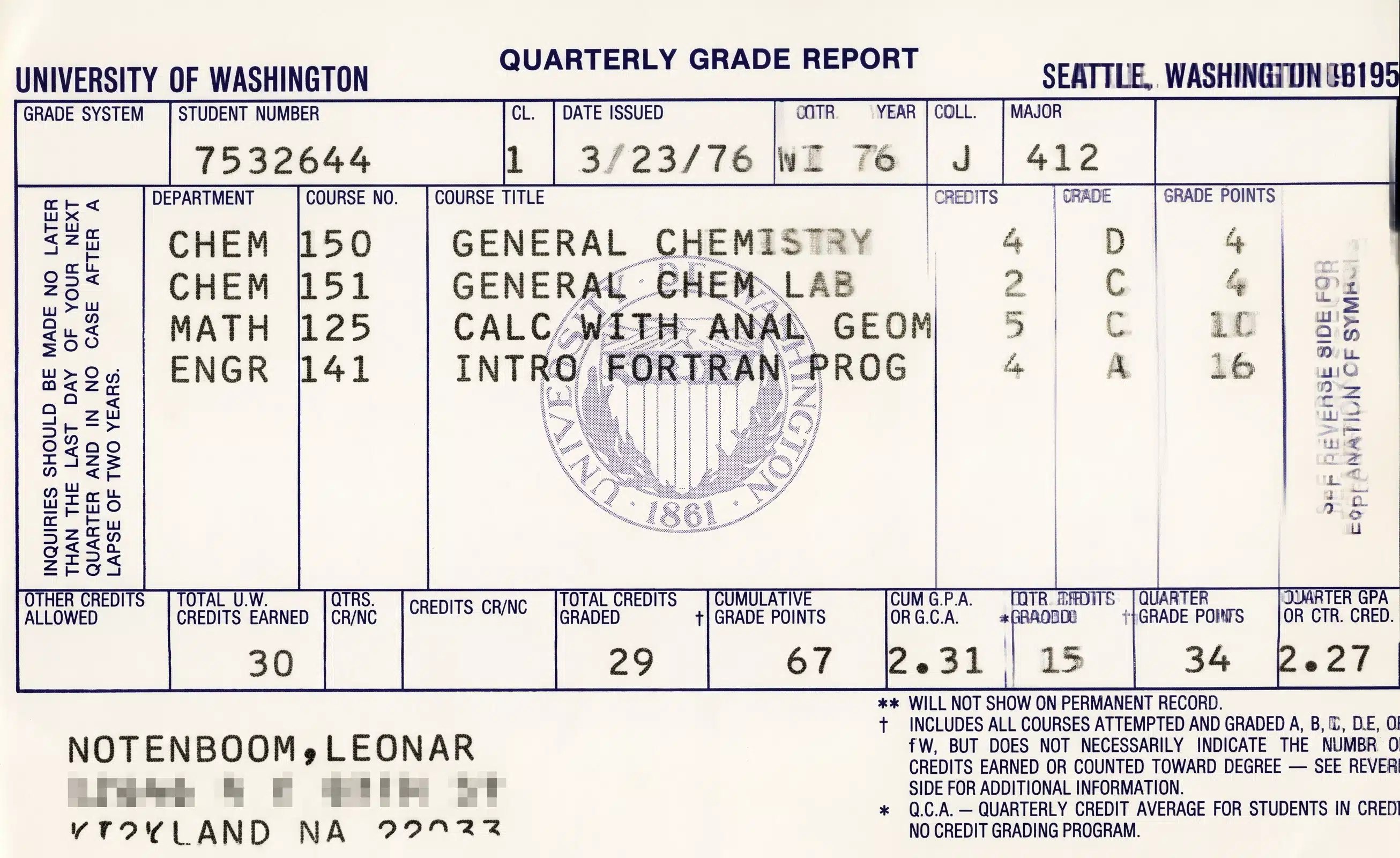
I first encountered a computer in January of 1976 — half a #*$@*! century ago — and as I’ve discussed elsewhere, it was love at first sight. That this could be a career thrilled me.
The intervening years have seen me:
- Program that first computer, a CDC 6400 mainframe, using punch cards.
- Buy my first computer (an Apple ][).
- Fail my first job interview miserably because I couldn’t do hexadecimal math.
- Work on a family of 8-bit-processor-based data entry terminals (writing and supporting everything from communications programs to programming languages to operating systems).
- Move to a small1 company in Redmond called Microsoft to work on some of the very first PCs.
- Play with an assortment of technologies over the next 18+ years, ranging from programming languages to applications for one of the world’s most popular internet sites.
- Leave a large2 company in Redmond called Microsoft to “retire” at age 44 and have a little more time of my own.
- Hook up with a band of internet entrepreneurs and start my own online effort, now known as “Ask Leo!”
- Continue to play with an assortment of technologies to write, program web apps, design websites, create video and audio content, and, of course, answer questions.
It’s a long list, and I glossed over more than a few things to make it as short as it is.
Hidden in that list is something important.
Help keep it going by becoming a Patron.
Related

The Most Important Skill
Think the most important skill in tech is coding? Nope. Whether you're asking for help online, applying for a job, or using AI, writing and speaking English well matters more than you'd expect. I'll explain why it might be the most valuable skill of all.#6166
The 50-year takeaway
There’s nothing at the bottom of the list that could have been reliably predicted by what came before.
Put another way, there’s no way I could have known in 1976 what my work in 2026 would entail, other than the vague terms computers and technology. Things are moving too quickly in directions we can’t guess to make long-term predictions, much less long-term commitments.
Here’s another implied takeaway: that’s not going to stop.
The ramifications of change
In past eras, we could train for a job, skill, or career at a young age, do that job for the majority of our working lives, and retire.
One job — one skill or set of skills — was all you needed for your entire life. As long as you were good at it, it was something you could count on to keep you active, feed your family, and meet your needs.
That is no longer true.
It’s no longer true for the majority of careers, not just the technology-related ones. You see it all around you: as things change, the underlying infrastructure changes as well. Take coal mining: as energy production moves to cleaner and more efficient sources, the need to dig black rock out of the ground is declining. For coal miners to remain productive, they need to discover new skills and new careers.
You can no longer count on doing the same job until you die.
Related

The Most Important Attitude
There is one approach to life -- one setting in your psyche -- that affects your experience with technology much more than any lack of skill or knowledge.#6178
The ramifications of the ramifications
To bring this back to my friend’s young child, it means this: the skills you learn in school are less important now than they ever were. You can be certain that the skills needed to remain useful will change significantly over your lifetime, and the implications of such change can be dramatic.
What if your doctor is offering advice that has been rendered obsolete since they finished medical school?
— Shane Parrish, Half Life: The Decay of Knowledge and What to Do About It
Knowledge changes. What were once accepted facts are continually updated, refined, or replaced as new information, technologies, and tools become available. This is how science works.
It’s no longer enough to go to school and get a job.
You need to stay in school for the rest of your life.
You can never stop learning.
The most important skill for my friend’s young child
“The faster the pace of knowledge changes, the more valuable the skill of learning becomes.”
— Shane Parrish, Half Life: The Decay of Knowledge and What to Do About It
My friends were pushing their child to become a doctor.
My position? Besides “don’t push” (let the child decide for himself what his calling should be), my advice is to focus those energies elsewhere. Focus on learning how to learn, how to question, how to think, and how to fail and benefit from the experience.
I won’t say that what someone chooses to focus on today is irrelevant; it’s not. My first encounter with punch cards in 1976 set a chain of events in motion that led to my current situation. But how I handled the chain of events is more important than the choice of punch-card technology.
At each step, I had to learn something new. I had to learn how to solve problems I’d never encountered before — problems that didn’t even exist before. I had to learn how to question and reevaluate previously accepted wisdom. I had to learn how to fail and how to take away important lessons from each failure.
All of that led to something completely unpredictable: today.
Do this
My 50-year takeaway?
Teach your children how to learn so they can be ready for a future you can’t even imagine.
Subscribe to Confident Computing! Less frustration and more confidence, solutions, answers, and tips in your inbox every week.


Leo –
Right on – who knew what the future would hold? My first job in the computer industry was with a small start-up called Control Data Corporation, and their computers (1604, 3600, etc) were big enough to stand in. Today my cell phone has more technology in it. What’s next?
I enjoy your column – always something of interest for an old guy like me.
That punch card computer I started with? A CDC 6400. 🙂
That was my first computer in college too. I remember we’d constantly try hacking it to crash the system and do other stuff we weren’t supposed to. The card system made it completely anonymous.
Leo,
You said it! I joined the USAF after high school in 1960. After ten years, I got out and started computer work using the punch card, as well. I went back to school to learn computer technology. Before I received my Associates Degree in Technology I got a job with DataPoint Corporation. DataPoint was the originator of the desktop computer: the DataPoint 2200. It had a cassette-based operating system, a whopping 16K of internal RAM and each unit sold for over $30,000. And look where we are now. I have gone on to get both my Bachelors and Masters degrees in computer technology. I have always said: “Education is a journey; not a destination.” I’m 76 now and still learning. Keep up the good work and keep those messages coming.
Bill I started my IT career in 1982 in South Africa at a manufacturing company that had a Datapoint. The first language I learned was Databus… I cannot remember where the word Arc fit in but it rings a huge bell. Thanks for the memories!
Imagine how different your life would have been if you were better at hexadecimal math and got that job. I rarely used hexadecimal math. I bought a Casio hexadecimal capable calculator instead 🙂 .
“Imagine how different your life would have been…” is a statement that applies to many, many things. 🙂
Yes, sometimes our failures are successes in disguise.
Here’s an attempt in the early 20th century to predict Y2K. They got the Roomba, commercial flight, fighter and bomber planes, air mail, helicopters, mobile homes, submarines, tanks, computer synthesized musican and aerial firefighters right.
https://www.washingtonpost.com/news/wonk/wp/2015/10/04/what-people-in-1900-thought-the-year-2000-would-look-like/
“Teach your children how to learn, so they can be ready for a future you can’t even begin to imagine.” – Aye. Who’d have thunk that people would be able to make a living, and a very good living in some case, by live-streaming themselves playing video games? Or creating YouTube videos? Or search-optimizing websites? Or flying drones? Or……
We don’t know what the future job market will look like, but we do know some of the skills that will be needed: entrepreneurship, adaptability, problem solving, communication, the ability to negotiate and collaborate, curiosity and imagination. And the development of these skills is something our education systems should be placing more emphasis on developing.
These are all skills you can only learn by doing. So maybe we have to give our young people more free rein, letting them chose to work on projects that interest them rather than following a set curriculum, as in the Montessori system.
Thanks Leo,
I am 82 y.o psychiatrist and still working (part time), learning every day. Your ideas about continuous learning and questions about the future i sent to my many friends and colleagues.
As a fellow dinosaur (also started on punch cards and paper tape), I would like to offer some more general advice. Don’t waste the best years of your life waiting for the best years of your life.
Learn to learn. Really good advice. I see so many now that learning seemed to revolve on test taking, thus not really learning how to survive. I did 4 navy years (sonar tech) after high school then went to U. Temple CC and got my AAS in Electronic Engineering, ending up at Bell Labs in research. I spent 35 years there, constantly learning new technologies. I didn’t actually further my degree, but took many courses over the years, including a number of masters level versions. The environment required that to survive. I retired in 2001 as a Member of Technical Staff and over those years worked with some of the brightest people. Today I still try to keep up with what is happening, though it gets harder each year. But I try to learn something new as often as I can.
My advice to young people – learn something new every day.
My first computer ran CP/M software and was used as a bulletin board while a bearded Bill Gates (who in their right mind would give this hippy money?) was trying to formulate DOS as an operating system. The BBS had a massive 64 bytes of memory and had “doors”. Those who are under 70 need not bother to even read this message. Self taught and still learning but having trouble “keeping up.” Once had a dictionary sized book with all the DOS commands, and it was years before I would convert to “Windows.” I am a dinosaur in a modern world.
I can’t read your comment now. I won’t be old enough to read it for another 364 days 😉 .
I don’t think I’ve ever seen Bill with a beard. (His co-founder, the late Paul Allen, had one.)
Our first computer was an IBM Model 30 286 running IBM DOS 4.0 with DOSShell. It had a 20 MB hard drive, a 16-bit 10-MHz 286 CPU, 512 KB of RAM and cost $3617 in December 1988 including sales tax. My first computer book was the outstanding “Running MS-DOS” by Van Wolverton. One of the first programs we bought was Quicken, an updated version of which I still run today.
Thanks for the wisdom, Leo. Too few people take the trouble of imparting wisdom on the current generation built up and aggregated from many years of (sometimes painful) leaning’s. To take the trouble, time and effort to do this speaks volumes about your kindness and care as a human being.
Many thanks, always,
Dorian
Learn to learn and to think. Words to live by for sure. Sadly, more and more a lost skill.
But I can’t believe how young you all are. I first learned programming on an RPC9000 made by the Royal Typewriter Corp. That was around 1959-60.
In January 1964 I began programming on an NCR315 computer which had 10k of memory. You entered programs on punched cards which were fed into a system that changed the input to output cards that could then be fed into the computer and executed (one program at a time). The next USAF assignment was a 5 year stint at the Military Personnel center. We created a program that controlled all military personnel activities at base level throughout the world. Next was a 3 year stint at Hq Pacific Command in Hawaii. Next was military retirement followed by a 20 year stint as a programmer for a military contractor. Next was retirement with Social Security but I still write an occasional program using Visual Basic.
And here’s another implied take-away: it’s not going to stop.
But… it could! All it would take is a series of EMP’s world wide and we’d be essentially back in the dark ages. And then what would all the snowflakes be able to do then?
Unlikely? Yes. Improbable… unfortunately no.
Actually that would simply be a reboot. Change and the need to keep learning would simply start over.
You are right on. I started working in 1966 on the Univac 1004 and Univac 1108. The 1004 was a card reader and printer that was used to feed programs to the 1108. I went to school on the 1004 for 3 months and on the 1108 for 6 months. I went from there to a Xerox Sigma 7. 2 months school for it. From there I worked on the VAX 11/780. 3 weeks school for it. The saying that I like is” The ONLY constant in the pursuit of PERFECTION is CHANGE. I am 88 yrs old and still learning
I started on an IBM 1401 writing Autocoder programs. I was fortunate enough to work on the second IBM360/30. Many Assembler programs followed. DOS system software some came calling and was in the OS side forever. Applications were not to be understood but merely tolerated. My first OS sysgen in 1969 on an IBM360/75 was all in punched cards and occupied 5 trays as I recalled. It took over 4 hours to complete. I managed system software support groups at various and sundry in the early 70s. Began playing with Microsoft based PCs that you had to assemble from a Heath kit in 1980. Most of my groups did both mainframe and PC software in those days. Finally began concentrating on Windows in 1993. Wound up in 2001 leaving the management dodge and learned SQL Server and spent the rest of my career as a DBA (the best years of my career). Finally hung ‘em up in 2014 after 50 years.
I still dabble a little in the Windows installation and maintenance areas. I have been a Microsoft Insider for a couple of years and look forward to the new builds (of course I am in the fast track).
Most schools have been wrong in their teaching. I had one teacher that taught the way to learn is to teach how to learn, to search, to interpret. Schools teach from a book, learn the book and go on to the next book. It’s already outdated. Imagine learning to milk a goat from a book. Your Computer starts, mine was a Z1000 Sinclare. Well it was portable and did Amateur radio stuff so back in the 80’s, it was under $100 and available. Electronics as a whole has advanced so fast that you need a book to keep up. But the book is already outdated.
JR,
The one most valuable lesson I ever learnt, came from my father in 1955 when I was starting Secondary school at the age of 11. He said, “You do not go to school to learn that 2 + 2 = 4, you go to school to learn how to learn.” Now at the age of 74, I am still learning.
I’m not sure we can instill a desire to keep learning. Some of us are born with limited “vision,” and will never understand that life can be different no matter what we tell them.
Then again, I think of myself in the 1980s, in my forties, certain that personal computers are useless, good only for collecting recipes or playing silly games. That changed in one day in 1989 when, in my first day at a new assignment, I was informed one of the most important parts of my job was to produce a weekly report for the battalion commander. (Printed on five sheets of fanfold paper on a dot matrix printer, horizontally, end to end.) Those minutes changed my life. It was sink (get kicked out of the Army) or swim (learn DOS to produce the report).
I was lucky to have an office mate, the Signal Officer, ie, not his job to help me, who got me through the first few weeks. Meanwhile, I was studying pirated computer books bought in Seoul book shops and practicing at night on the office computer, bringing it back to life a few times with also-pirated Norton Utilities.
I came to love computers, leading me later to teach basic courses, and after my Army career to work as a deskside tech in dangerous areas that required high security clearances. Now I’m working on my memoir, a probably futile attempt to pass on some wisdom to my grandchildren, and possible only thanks to MS Word, which organizes my Table of Contents, sequentially numbers my footnotes and, most important, lets me add graphics scanned from my photo albums or
inserted from Google Images. Being able to leave the memoir behind has given me much peace of mind.
My life’s only regret may be my lost decade, when I stubbornly resisted the coming of this new technology, unable to see its promise.
40 years in one job is starting to seem like a rare thing these days.
I’ve spent 43 years, (and counting), in the one full-time job rewinding and redesigning electric motors, generators/alternators and transformers, changing from a time, (1975), when everything from the tiniest fan motor or coil would be rewound, to the ‘modern era’ when it’s not financially viable to rewind a standard 200 H.P. motor. Aside from service jobs, the only motors that tend to get rewound these days are ‘specials’ or the bigger motors, generators and transformers. Luckily enough, Tasmania has a fairly large mining and industrial base to keep the work coming in for the foreseeable future at least.
Like Tom Hunn, I’m still learning, and that’s a good thing.
As for computers. My first was a ‘Spectravideo 128’ that came with a 28.8 Kb modem that had me fascinated watching a jpeg(?) materialize line by line as it slowly downloaded. The good old days.
Well put Leo. I was lucky in having one teacher who, on his first day with our class, declared that ” if it is the last thing I ever do, I will teach you (Expletive deleted) lot how to learn and make you think.” He did, sometimes the hard way! While we are reminiscing my “first Computer” use was a 1962 ICT 1300. Thanks for many years of info & tips with !”Ask Leo” & get well soon. I had pneumonia and learned that you must take is easy & rest, Regards
We have generations (grandparents, parents and “children”) that all worked in computers, now. Retirees sitting on the porch in rocking chairs is a thing of the past. I started in 1969 on an IBM 360/30 with 32k memory and a dozen big cabinets with peripheral devices and control units. Learning operations, programming and systems design was an empowering and thrilling experiences I ever had. I’m still using computers (and Leo’s Tips) and don’t ever expect to stop.
You wrote:
“…Work[ed] on a family of 8-bit-processor-based data entry terminals…”
My own first computer system was the 8-bit, 1Mhz, Commodore-64 (which later became a Commodore-128). I still have &use it!
Wish I still had my Commodore-64! Also my first; my mom threw it out when we moved (and also my record player 🙁 ). I can sure relate to Steve, above: I was good on that thing – I wish I had realized where the industry was headed – I would have stuck with it! Still learning now, though!
First experience was with a Radio Shack TRS-80 with a cassette tape drive and the optional ‘memory chip upgrade’ expanding it to something like 60k. ‘Programming’ was done by copying off sheets of printed data, by hand, into it’s memory. Of course, one typo anywhere in the process screwed the whole thing up. Viewed as a toy? OK. Viewed as a career? Nope.
Thanks for all the comments. Let’s discuss what the learning methodology should be that you teach to kids. I got a PhD in artificial intelligence in 1971. In doing that, I certainly learned how to learn, but it took a while. My curriculum through college was always well advanced- I wrote my own degree requirements at each step. The reason I bring this up is that I was well into my MS in Biophysics when I took a course in Probability Theory- I got a “D”. Subsequently I took a course in decision theory. The light went on! From that point on, I didn’t really have to study, even though I took the most difficult courses in science and technology offered at a large university…. The discovery: other than applying decision theory, I began using mind mapping in my head, without forcing what I learned into English. The closest formal concept that mimics this is UML plus mental Petri Net models. I really do think and learn that way.
By the way, I have described this as “visual” modelling. If someone isn’t “visual”, then there is a way, through a kind of musical visualization on the auditory cortex to get the same effect. I learned that later in life, when I started singing Black Gospel instructed by a person from a Gullah background. There is no written music, either the music or the words. So we learned the music by repetition. We sang the words, but we didn’t really memorize words. I couldn’t tell you any of the words to any song. But start the music, and the words just come.
All this to say I am teaching this way to learn to my grandkids. And I encourage all grandpas and mas out there to teach your grand children to learn, and the way to learn can be found in the key concepts of artificial intelligence.
The kids are 9. They are in a Chinese immersion school. Their verbal and head languages haven’t been “locked in” yet. So this way of thinking is just another language to them. It is kind of a language of unlanguage.
Some principles: Learning is a conscious effort, but it is not work. Be confident of it- don’t force it into any verbal language. Build yourself a conceptual structure and start hanging concepts and methods on that structure AND, most important, start building relationships between them. Be comfortable with and recognize uncertainty. Remember the uncertainty and add it to your conceptual model. Pay attention to the preconditions: think in Bayesian. No matter how much you “know”, you will have difficulty applying that knowledge without “people skills.” Very few people will get your way of thinking. You will need to learn to translate to their way of thinking and be a teacher in their world. Learn these skills early.
The first computer I was involved with was the Illiac 1 (programming) and the Illiac 2 (technician) at the University of Illinois in 1959/1960. The Illiac 1 made use of the Williamson Memory (look that up) made from CRT tubes (1024 bits per tube). The Illiac 1 was constructed using 6SN7 vacuum tubes and discrete components. The Illiac 2 was constructed of those new fangled Transistors. Both of these computers took up half or so of a medium sized building, and the power supplies were in the basement.
Wow, 6SN7. That brings back memories. I remember we had to replace that same tube several times on our old Admiral black and white TV in the 50s. I can’t believe I remembered that number when you mentioned it. I guess it’s because we changed it so often.
Harvard Business Review just had an article called “Identify — and Hire — Lifelong Learners” as the key to hiring and identifying your best talent. A lot of the same themes as in Leo’s article a few years ago:
https://hbr.org/2021/05/identify-and-hire-lifelong-learners
On my first job interview at Texas Instruments, I was asked a simple question, “What are the 4 sections of a COBOL program.” I didn’t know the answer. I told the interviewer I didn’t know because I kept a template with all the stuff that’s in every COBOL program and filled in the sections without memorizing the names. He was satisfied and I got the job. And seriously, who does Hex arithmetic in their heads?
Not me. Still. One of my criteria for calculator apps is that they also operate in hex.
That’s one nice feature in Windows. It comes with a built-in programmers’ calculator with hex, decimal, octal, and binary. One computer I worked with used octal, the Wang MVP. That was one crazy machine. It only ran BASIC, and the system commands were all in basic and it didn’t support compilers. It had 256 K RAM and could support up to 12 terminals, but 6-8 was a more feasible number. That BASIC limitation turned out to be a blessing in disguise. While we were doing systems for the Wang, the first PCs came out and I could easily port all my programs to BASIC on the DOS machined with a little adaptation to account for differences in the language on each computer. It was also a good learning experience for the interns as they did the adaptation along with the transcription.
Your video should be shown to every high school student. While most will be focused on their immediate lives, some will be smart enough to understand. BTW, my first job was as an electronic technician at GE aligning and troubleshooting radar and missile guidance systems. That was from 1959-64. Back then, the rate of change was so slow that I didn’t have to upgrade my skills set!
While now things are changing aw warp speed, I see the positive aspects of that. It forces me to be adaptable and to learn quickly — rare capabilities for anyone in their eighties!
Honestly, it’s one of the reasons I love my career choice. There will always be something new, something challenging, and something fun to learn and keep sharp.
I worked for GE one semester in college at their main factory in Lynn, Mass. Did you work there?
Your advocacy for teaching “the skill of learning how to learn” is spot on. Honing this skill was the most important part of my education in mathematics at a university almost 50 years ago. Helping people to learn how to learn has been one of the most rewarding parts of working through changes in hardware platforms, evolving languages and programming techniques, finding solutions, and understanding how to solve problems. Getting yourself into the attitude of always willing to be fascinated fuels the excitement and enjoyment of everything you encounter, whether in tech, art, society, or nature. Thank you, Leo, for enriching our lives.
You said: “Teach your children how to learn…” I agree. Could you elaborate on how to do that?
First, congratulations to Leo for 50 years of computing.
Most people who learn new things do so because they enjoy it. Remove the intrinsic enjoyment and curiosity and not much learning happens. You can’t teach someone “how to learn” beyond providing them with the means (time, books, computers, labs, etc.). If someone doesn’t have curiosity, they won’t learn much beyond the minimum necessary to pass some mandated test. For most people, learning comes from immersion into an experience, such as a job. School is a form of short-term, concentrated immersion, but it’s typically forced on most people. Forcing children to learn something they have no interest in will backfire (for them). On the other hand, allowing them to go to college and learn about their passion for basket weaving won’t turn out much better. The internet is blazing with testimonials about many hundreds of thousands of dollars in student dept pursuing passion.
Perhaps the answer is teaching children about how the real world works, versatility, adaptation, hardship, work ethic, sacrifice, planning and goals, and ultimately realities of getting older. People become successful in every field and endeavor, but that’s not because they just have a passion for it – it’s because they can translate their capabilities into rational and pragmatic businesses or livelihoods.
Set a good example.
Honestly, though, that’s a question for the ages. Not being a parent I don’t have tactical advice.
My math teacher who taught Algebra II, and Trig. told me I should get into computers my Senior year of high school. I thought it both sounded boring and would never be that big of a thing! lol Her fear was that I would end up working in a gas station! My first job in 1969 was for Standard Oil of California at the San Francisco airport gas station. I wonder if I’d been motivated to go to college and study computers if I would have flourished. I tend to doubt it, but I was certainly wrong about computers.
Leo you are so right on picking what you want to do as opposed to what others want you to do. I took math and chemistry in university but in my final year also took a programming course Fortran IV. Next semester it was Assembler and I was hooked. First job was a programmer in PL/I and Assembler on an IBM 360 Model 50 (which BTW is now in the Smithsonian). From there it was on to many management positions, but the basis of programming was always useful no matter what I was doing.
Over the years I have said the same thing to many younger people, do what you like to do BUT never stop learning.
Does anyone remember the Sinclair ZX-80? That was the start of career in information technology.
Great recommendation. From blowing off my MBA studies to take a couple of undergrad programming courses, I continued to follow my nose to coding for a living, DBA, system analysis, business mgt, people mgt, going back to university to learn statistics, and finding love again doing data analysis in SAS for a financial services company. I make a lot money and never had to ask for a raise.
I started in ’63 as an undergrad at McMaster U in Hamilton ON. Fortran 4, punch cards, z-fold print out, and 3 runs per day. No instruction. Course was math analysis, and all assignments were to be coded—real baptism of fire. Now 84yo and still doing some coding allthough most in autohotkey.
My first experience with any computer was either the Commodore Vic 20 my family was given that had no form of data storage, so to do anything we first had to enter the code from a user’s guide or let it sit dormant, or an IBM terminal, entering data for the company I worked for in the late 1980’s. Those were soon followed by a Commodore 64 that had a big heavy floppy drive, so we could load games or programs from 5.25-inch floppy disks that weren’t really all that floppy.
A few years later, my Wife and I purchased a Gateway IBM-Compatible PC that had 640 Kb RAM, a 100MB internal MFM hard drive, and a 14″ color monitor, powered by MS-DOS 3.1 so she could do her homework for the Business Machines course she was taking at a local college.
I worked as a small package courier guard at the time, earning what was then considered a fairly good pate of pay, so computer technology became more of a hobby for me than anything close to a career, although I did work as a Cable Internet Technical Support agent for a few years, but I chose another path following that experience, because my true job was to get the customer off the phone whether I was of any help or not – I couldn’t stomach that.
While I haven’t put in a full half century dealing with computer related technologies, I’d guess that, heaven willing, I’ll get there in the next half decade or so, and as Leo says, I have no idea what computer related technology will look like by even then, although I suspect that the equivalent of what we call computers today may consist of a pair of glasses (or some new technology to get images into our eyes) with built-in hearing-aid-like ear-pieces and perhaps some sort of cigarette pack sized object that will be the equivalent of what we call a computer case today (housing perhaps the power supply/battery/energy-source, data storage device(s), and perhaps RAM – but these are only guesses. Who knows what the reality will be, so I look forward to being as amazed at the coming changes as I have been by the evolutionary changes I’ve been witness to so far!
Interesting your review of 50 years in the IT field.
I too had some similar experiences. At the University of Texas, Austin, they had just built a new Business and Economics building. In the basement, they had a CDC 6600, using punch cards for input. As a business major, I took a course in statistics, which required much programming (on punch cards) time in the basement. Of those programs, the one I remember most was the regularly assigned class project to interview on campus students about where they were traveling from and where to. We were then to write a program that would redesign the campus layout (buildings) to make travel more efficient. The end result had all the male and female dorms bunched together and the class buildings encircling the dorms. Turned out that this result was the most common – guys and gals visiting each other was the most common trip.
My first computer was an Apple II Plus
I went on, initially, to become a Master Typographer, which led to using early database programs to convert mainframe data into catalogs, directories and price books. I developed ways to capture the original data (and word processing files) to avoid having to reenter the text.
These programming skills lead to a long career as a programmer (including writing early hospital medical record systems), data center developer, enterprise architect revising business processes – particularly human and computer processes and the associated interface links. I always felt it wasn’t work, and so enjoyed it I would have done it for free.
Your absolutely correct – the key is continuous learning.
Fortunately, in 1969, I took an Introduction to Engineering course where we were taught “Digital Computing and Fortran IV with MTS”. Over half of the class dropped the course, but I loved it. I was at the University of Michigan, using a duplex of 2 IBM 360/67 systems which had “virtual memory” and a common interface “Michigan Terminal System” that replaced IBM’s JCL and TSO.
The duplex 360/67s had a grand total of 2 MB of magnetic core memory and 470 MB of disk storage, but it was enough to support faculty & student batch jobs and timesharing. Later, I took a PL/I (best of Fortran & COBOL) programming course, and that set me off on an eventual 39 year career in IT.
57 years later, I still use the “learning how to learn” and problem solving skills gained at Michigan to explore new interests, both technical and interpersonal.
One big thing for me is asking the right questions.
Early in my career I was given a project, and was having difficulty making any progress. I went to see my boss, explained the situation. and he asked a couple of questions that I couldn’t answer. But I realised that when I had the answers to his questions, the way forward would be obvious.
Fifty years ago? How about sixty-three years ago? My first experience with computers was at the University of New Brunswick in 1963. The computer was an LGP 30, it had a drum memory with a little over 4K words of 31 bits. Words, not bytes, bytes didn’t exist then. We program it in machine language. I recall that one exercise we had to do was to sort 50 numbers in ascending order, it took several pages of programming. Subroutines, e.g. sinus or tangent, were on paper tapes hanging on the wall which we had to feed into the computer as needed.
The next computer I used was an IBM 1620. Great improvement! We could program in Fortran and used punched cards. My first PC was a Macintosh in the 80’s. I’m 96 years old and struggling to keep up with an iPhone, and HP Pavillion PC and AI.
The first “computer” I built was a single-board SD Systems Z80 Starter Kit while an Electrical Engineering student in the 70s. I did not actually do much programming in my engineering career. I was much more of analog/RF engineer and basically just a computer user. I went from engineering to teaching for a few years, decided that the public education system was not for me. Started ‘working for myself’ fixing computers in 1999 and did that for about 20 years. People asked me how I learned to do that and the answer was I just read a lot and used the basic knowledge and engineering problem-solving skills I already had. Knowing basic facts and concepts is definitely important because that provides you with a foundation. You need to know the basics to be able to build more specific knowledge and skills, but definitely learning how to learn and how to approach problem-solving is key.
I remember mocking the nerds in the “computer lab” (whatever that was) back in 1973. They were in the basement of the oldest building on campus, cast offs. I’d come back from partying on a Friday or Saturday night and the computer lab lights would still be on, and I’d laugh to myself at how nerdy they were. Well, obviously, they get the last laugh. I bet most of them went on to have tech careers, while I never made use of my degree at all.
Leo, I was just a year later than. (1977) My first introduction was via the US Navy at Moffet field in California. As an Australian I was sent to study the on board Univac 1830 A in the Orion maritime aircraft. Our Airforce bought 10 of the P3C planes for our maritime patrols. I had to study down to inside chip level gates and the instructions. after retirment was involved with a local High School as the IT person as well as being the Science Lab manager. I am not involved anymore except for my own desktop.
I also first learned some programming in 1976 as a junior in high school. Once a week a small group of us would be driven to office in a neighboring town where we were given lessons, filled in coding sheets that would be transferred to punch cards by a clerk. Check the cards, run them thru a reader and then wait for the computer 40 miles away to run the program & return the results to a line printer.
Rinse & repeat when the printout told you that there was a typo in the 3rd line of the program….
We were taught 2 languages: SAMOS, an assembly level language design to illustrate the principles of computing and Fortran.
Wonderful look back. I started computer (aka Data Processing) at Olympic College in Bremerton, WA with a punch card and verifier machine in 1966. At that time we learned how to use sorting machines, printing machines (huge) and collators. Then on to the logic and stat classes and on to programming. We wrote in Basic, Fortran, COBOL, machine language and were able to take out punch cards down to Olympic where we could run the program on an IBM 3 huge computer! I don’t remember so well any more but things have changed so much and at my age, I can’t process the new stuff so well. Thanks for all your input!!!
Loved the photos in your 50 Year Takeaway and gave me a trip down memory lane. Started programming on an IBM 360 in 1963 using punch cards. l was working on a program in a room that faced the computer behind a glass wall when I heard JFK had been shot. Did not follow through to become a programmer but dabbled in the art with some of the first PCs (Commadore PET) and the skills laid a good foundation for my many years as an ME. Love your work.
Wow, I can certainly relate to this article. I started my career on an 8K IBM 360 Mod 20 in 1968 and ended up on a 128GB Apple iPhone in March of 2014. Your picture really shows the span and sure made me sit and do a nostalgic reflection for sure.
My first encounter with a computer was in 1955 as a first-year graduate student. The computer was an IBM 650, which occupied a large room with accompanying equipment, and had 4K words of memory on a drum. Time could be reserved in 20-minute blocks in the daytime, and up to 1 hour at night, so there was a premium on doing mental de-bugging of one’s program before venturing to the machine. The local paper, the Pittsburgh Press, published a contest challenging, in a 25×25 array of numbers, to find the highest-scoring zig-zag path of 25 numbers total length, subject to rules on segment lengths in the path. I decided to take on the challenge and wrote a program with a rather rudimentary algorithm for trying paths. I reserved my night-time hour on the computer, ran the program for the full hour, and then examined the best it could find. It turned out that by looking at the array, a better path could easily be found visually. I abandoned that project but never really forgot it. A few years later, I used that same computer to process the data for my PhD thesis.
After graduation, I started work at Bell Laboratories, which had an IBM 7090, and I learned to program in Fortran that first year. Although I loved working with computers, my career path led to analytical and scientific work and eventually management. I bought my first personal computer when Bell Laboratories in 1984 offered employees a special price on AT&T PC 6300 computers with 2 floppy disk drives and 64 kB memory, made by Olivetti.
Following my retirement, our local high school opened certain courses to senior citizens, and one was Pascal programming. I jumped at the chance and found it very stimulating to share learning with youngsters one-quarter my age.
After completing the class, I decided to revisit the puzzle challenge I encountered many years before, using Turbo Pascal to write the program. With all the computer power now available, I didn’t need any fancy algorithms, but just used brute force, examining all the possible paths and selecting the best one. I also wrote a program to run or solve the peg-jumping challenge popular in the Cracker Barrel restaurants. Unfortunately, all the Turbo Pascal programs are 8-bit executables which can’t be run on today’s computers.
I now use a Lenovo laptop with 1TB storage and 16 GB memory, which cost me less than that PC6300 more than 40 years ago.
It’s been almost 72 years since that first computer captured my imagination. I marvel at the progress that has occurred. I can only imagine what is in store as artificial intelligence grows exponentially.
All: Thanks for the history and related comments!
Back in 1969 with a liberal arts education I was hired as as a trainee “Computer Programmer”. Two weeks of machine language, two weeks of assembly language, and two weeks of COBOL on an RCA mainframe and “I are a programmer!”. I would go home at night and tell my wife that, unbelievably, they were paying me a good wage to solve puzzles! What fun! Coding long hours per day and calls at night to solve “System Down” problems from computer paper dumps a foot high were my early experiences. Later that morphed into systems analysis, managing end user requirements, managing data centers, and international project management. A good career which gave me early retirement in 1998.
In the lesson’s learned category, from punch card days.>>
Never run down a set of stairs with an open box of punch cards.
A classmate lost 4-5 hours resorting an 800 (about) card deck, Fortran program plus data, after tripping in just the wrong way. The deadline for the project was the next day.
Corrupted media always happens at just the wrong time.
From another techie with 58 years of experience.
If asked to do something you don’t know, say YES! The real advances in my computer career came when I took on an assignment I knew next to, or absolutely, nothing about. Much of what I learned as a result is outdated BUT it set me up to learn the next bigger and better thing. Expertise does NOT magically happen it is built on the past and the past is full of failures. Don’t stop learning. And most of all HAVE FUN!
Everything I said also applies to life away from the computer. I am entering a new phase in my life as a widower and I intend to apply the same rules to this phase of my life.